

Staying Indoors
She won't stop running around the house!
I have no energy left, I am so tired!

He just cant relax!
We have no spare money, I have no idea what do to?
When the weather is miserable and the thought of putting on waterproofs and getting outside feels too hard to manage, there are some simple, free/low-cost activities which you can set up to break up a long day at home.
Having easy to hand activities for your child to access and engage with alongside you supports positive relationships and offers your child a space to regulate their emotions, whilst also balancing their sensory experiences.
There are also some activities below which can be completed independently which are great for times when you need to have a 5 minute breather or need time for household jobs.
Completing activities alongside a trusted adult helps children develop language, reasoning, and observation skills.
The more children spend time talking and exploring with others, the more they can explore problem solving skills, thinking skills, reasoning skills and language development.
Throughout this page we hope you can find some ways to enjoy staying indoors with your child.
Whenever you see this symbol  there is a linked website article for more information
 Click HERE for a printable version of Staying Indoors
----------------------------------------------------------------------------------------------------------------------------------
Having zones or identified spaces in your home can really help your child to learn where they can go if they are feeling the need for something energetic, something calming or something focused.
Here are some ideas of spaces you can create in your home. If space is limited, then items associated with each area can be placed in a basket and taken to a space when needed.
All of the activities in the grid below have been categorised according to their main focus, however, children are all individual and you may find a calming activity which then has an energising effect on your child.
Feel free to move the activities around depending on your child’s preferences.
The activities named below do not need to be purchased items – you will find below the table, examples of how to use things around the home to create these opportunities.
| Energising Activities | Calming Activities | Focused Activities |
|
Indoor Bowling
Find the hidden teddy
Making coin trails and pictures (Maths challenges)
Den building
Baby care / toy washing
Peg hunt
Jump to the word / letter sound
Junk modelling |
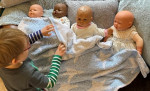
Blanket snuggles
Calming sensory bottles (see recipe below)
Range of magazines / books / catalogues to look through
Toy movie night |
Melting ice challenge
Threading challenge
Feather blowing
Cushion / balloon tennis
Measuring me (Maths challenges)
Making rainbows
Home café
Baking |
----------------------------------------------------------------------------------------------------------------------------------
Skittles/bowling alley
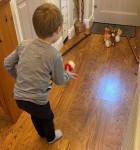 Using a pair of socks rolled up into a ball and some empty plastic bottles set up your own indoor bowling alley.
For budding mathematicians, you can add numbers appropriate to your child’s stage of development onto the bottles using a permanent pen. Encourage your child to bowl down a certain number or to bowl down several bottles to make a given total.
@LuPears
---------------------------------------------------------------------------------------------------------------------------------
Find the teddy/toy

Take it in turns to hide the toy around the house. You can use hotter and colder clues as the 'finders' move around and get closer or further away from the toy.
Pexels Image
---------------------------------------------------------------------------------------------------------------------------------
Melting ice
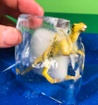
Using an old ice cream tub = fill it with water (add food colouring drops if you want to make it colourful). Let the children explore how to make it melt in the bath/ outside. Added fun = free the frozen toys (pre-freeze small plastic toys).
@fizzicsed
----------------------------------------------------------------------------------------------------------------------------------
Make a den using cushions/duvets/pegs and clothes airer
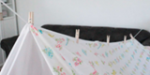 Grab some towels, bed sheets or blankets and some pegs. Find some chairs or furniture which is safe to tie/peg the fabric too and make a cosy nook to hide and play in. Homemade dens are great because they can be made differently each time and cost nothing! These are great spaces to read in with your child or have a picnic lunch in hiding! Pretty Providence have some fantastic top tips and ideas for den building on their website How To Build The Best Blanket Fort - Pretty Providence.
@PrettyProvidence

@LuPears
----------------------------------------------------------------------------------------------------------------------------------
Threading Time!
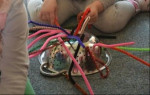
Using string or pipe cleaners, encourage your child to thread through holes or poke pipe cleaners into the holes and pull them out again. Empty tissue boxes with scarves/pieces of cut up old clothing are also a really good busy activity for younger children. @PickleBums has some great ideas on her website here. You can also re-use boxes and make then into ball games, cutting holes and encouraging your child to roll the ball into the spaces or hold the box and roll the ball around in the tray space avoiding or aiming for the holes whichever way you prefer to play the game! @snapdragonsnursery have some more ball drop ideas on their blog here.
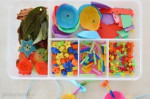
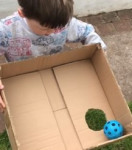
@EarlyYrsCareers @PickleBums @snapdragonsnursery
----------------------------------------------------------------------------------------------------------------------------------
Feather blowing/cushion tennis
Using a feather or balloon, play tennis across the room.
Blowing the feather across to each other – you can play a version where you have to catch the balloon on a cushion and then blow it back to the other person again from your cushion.
Using a balloon you can bat the balloon back and forth to each other – how many passes can you get in a rally to and fro?
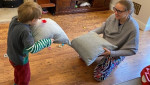
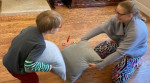
@LuPears
----------------------------------------------------------------------------------------------------------------------------------
Toy movie night
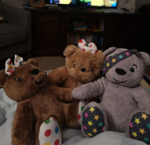
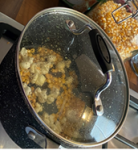
Encourage your child to set up their favourite toys and seat them all in the ‘cinema’ (room with the TV in). Draw the curtains, make a special drink and snack. Homemade popcorn is a really cheap and easy option to make and super fun for your child to watch the kernels pop! Recipe here.
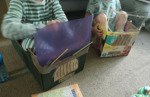
You can even make a drive in cinema by preparing recycling boxes throughout the day and turning them into cars for the toys to sit in – if the box is big enough, you can even have yourselves/your child sitting in them.
@LuPears
----------------------------------------------------------------------------------------------------------------------------------
Peg Hunt
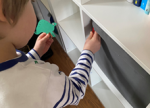
Hide some pegs around the home and give your child a cut out shape from a magazine or piece of carboard or an empty cereal packet works well.
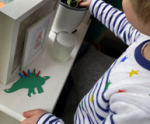
Challenge them to find all the hidden pegs. To support you can add clues of “you are getting closer/warmer” “you are getting colder/further away.”
@LuPears
---------------------------------------------------------------------------------------------------------------------------------
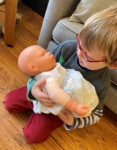
Baby Care/Toy Washing.
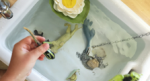 Fill up the bath with soapy water and give those toys a good wash! Children love splashing and cleaning things – plastic toys are a great way to introduce your child to
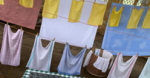 washing toys. You can also encourage your child to wash tea towels or flannels/cloths as these are great fun for them to peg out on a washing line.
 @LuPears
---------------------------------------------------------------------------------------------------------------------------------
Maths Challenges: Coin trails, number fun and measuring me!
Playing with coins is great fun and supports mathematical learning too!
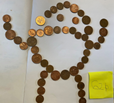
You can make trails of coins to follow like a treasure trail around the home, or make your own coin pictures!
For an extra challenge, you can encourage older children to add up the total of the coins used in each piece of art.
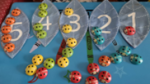 You can also match numbers and objects around the home with numbers, giving your child a challenge to find 3 yellow things, 1 red object etc. You don’t have to do this with a specific game – it is much more fun to find random objects of different colours around the home!
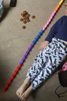 You can also practice measuring things using toys such as bricks and comparing how long they all are.

Measuring how long you and your child are can also bring so much laughter as you stretch out long.
@LuPears
---------------------------------------------------------------------------------------------------------------------------------
Letter sound/word jump
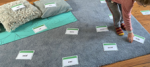 If your child comes home with words/letter sounds to learn – play hop/jump/skip to the word or sound.
Call out the sounds and ask your child to move to them to collect them.
Try moving in different ways, you can build mountains of cushions to climb or use rugs or fabric as a river.
Challenge your child to find all the words starting with a certain sound e.g. ‘t’ sound = too, top, tip, tap.
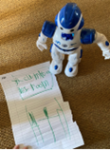
For older children you can encourage them to write clues or deliver messages using their favourite toys.
@LuPears
----------------------------------------------------------------------------------------------------------------------------------
Home Café
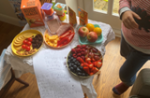 Set up a café for your lunch together – take it in turns to serve each other. Have fun preparing the food together – use this as a chance to use cutlery safely together and for older children teach them safe ways to cut with knives (see images below). Older children can also help write a menu to chose from and work out change if you have made any money to play with or have coins around the house you can use in the play.
@LuPears
Use this as an opportunity to teach hand hygiene and safe food handling to your child and by taking part in the preparation of food this is a good way to introduce your child to new foods to try.
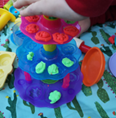
If you don’t feel able to manage this with real food – start by making salt dough recipe here or playdoh home made recipe here café first.
Always start with cutting soft foods on non-edible food like playdoh using a normal table knife to practice the safe holds for cutting.
There are some excellent food tips on Warburtons food skills page found here as below -
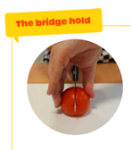
Bridge grip
Make a bridge with you supporting hand and cut through the archway using the knife.
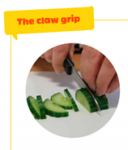
Claw grip
Make a claw shape and hold the food with fingers so that knuckles rest up against the blunt knife edge.
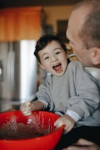

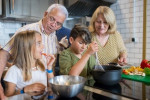
Pexels Images
Cooking
There is so much fun to be had baking with your child. Through cooking they learn how to develop healthy eating and drinking habits, food hygiene and develop new food tastes. Here is a link to the Healthy Kids Change for Life NHS website Home | Change4Life (www.nhs.uk)
----------------------------------------------------------------------------------------------------------------------------------
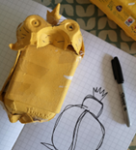
Junk Modelling
Saving up recycling and offering it to your child with some tape and scissors (with appropriate supervision and support if young children) can offer your child the freedom to be creative and express themselves.
If they need a little help give them a starter idea such as “Can you make an animal?”.
These creations can be as big or small as you feel comfortable with.
Bigger creations can then be used for a den space for a while until recycling day comes around again! Remember to give your child warning about when their creation will need to come down if it is a large one so they can prepare to say goodbye to it.
Remind them they can look forward to making more creations once these have been recycled.
@LuPears
----------------------------------------------------------------------------------------------------------------------------------
Sensory Bottles
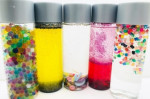
You can make sensory bottles using any objects around your home and placing them into recycled, cleaned out, see through bottles. You can add water and soap using the recipes suggested here by Mas&Pas Parenting Network or you can fill empty bottles with dried rice or pasta and leave them free of water to act like a shaker. Experiment with different textures and colours and see which your child likes best. Always remember to stay with young children using these bottles and it is advisable, once made, to seal the bottles using superglue and electrical tape to prevent leaks and ensure younger infants do not swallow any of the pieces or liquid in the bottles.
@Masandpas
Click HERE for a printable version of this page - Staying Indoors
With thanks to Somerset Educational Psychology Service (EPS) for their work with us in developing this resource page